



Karl Ritter : His Life and Zeitfilms under National Socialism
£35.00
In stock
Description
For readers with a serious interest in the cultural machinery of the Third Reich, Karl Ritter: His Life and Zeitfilms Under National Socialism offers a focused and revealing study of one of the most important—and troubling—figures in Nazi-era cinema. Rather than treating film merely as artistic output, the book situates Ritter firmly within the political, institutional, and ideological structures of the regime, making it especially valuable for those who view cinema as a tool of statecraft.
Any discussion of Ritter inevitably invites comparison with better-known figures such as Leni Riefenstahl and Joseph Goebbels. While Riefenstahl has often dominated conversations about Nazi propaganda film, Ritter operated in a different but arguably more systematic capacity. Working within the state-controlled film industry centered around Universum Film AG, Ritter specialized in the “Zeitfilm” (contemporary film), blending narrative entertainment with overt ideological messaging.
The book does an admirable job of clarifying how the Nazi regime viewed cinema not simply as propaganda in the narrow sense, but as a vehicle for shaping social attitudes, militarizing popular consciousness, and normalizing ideological tenets. Ritter’s films exemplify this fusion of storytelling and indoctrination.
One of the book’s strongest contributions is its refusal to separate Ritter’s artistry from his political convictions. Unlike some directors who later claimed artistic neutrality, Ritter was openly committed to National Socialism. The author carefully traces his ideological development, demonstrating how his personal beliefs aligned with regime objectives.
Detailed analyses of films such as Hitlerjunge Quex and Stukas show how Ritter crafted emotionally compelling narratives that reinforced themes of sacrifice, comradeship, and unquestioning loyalty. The book highlights the cinematic techniques—tight narrative arcs, heroic framing, and rhythmic editing—that made these films effective recruitment tools. Rather than relying solely on spectacle, Ritter’s work often grounded ideology in relatable, contemporary settings, making the message more immediate and persuasive.
For readers interested in the mechanics of propaganda, these close readings are particularly valuable. The author demonstrates how cinematic form itself—camera movement, music, character archetypes—became an extension of political doctrine.
A further strength lies in the book’s examination of the bureaucratic framework surrounding Ritter. The role of Goebbels’ Propaganda Ministry is not treated abstractly; instead, the author shows how funding decisions, script approvals, and distribution strategies shaped the final product. This institutional perspective prevents the narrative from devolving into biography alone and situates Ritter within the larger ecosystem of cultural production under National Socialism.
Importantly, the book avoids simplistic moralizing while never losing sight of the ethical stakes. Ritter is neither sensationalized nor exculpated. The author presents him as a committed participant in a regime that weaponized culture, making the study relevant to ongoing debates about artistic responsibility under authoritarian systems.
Scholarly without being opaque, the prose is well suited to readers already familiar with the political and social contours of the Third Reich. Those expecting a general introduction to Nazi cinema may find the book specialized, but for enthusiasts and researchers of the period, this focus is precisely its virtue.
The film analyses are dense but rewarding, especially for readers comfortable with both historical and cinematic terminology. The integration of archival material—production memos, correspondence, censorship records—adds depth and authority.
Karl Ritter: His Life and Zeitfilms Under National Socialism is a significant contribution to the study of cinema in the Third Reich. It expands the conversation beyond the canonical figures and demonstrates how ideology permeated mainstream narrative film. For those interested in how the Nazi state mobilized culture to shape belief, identity, and wartime morale, this book offers both a compelling biography and a sobering case study.
It is not light reading—but for serious students of National Socialist cultural history, it is an illuminating and necessary one.
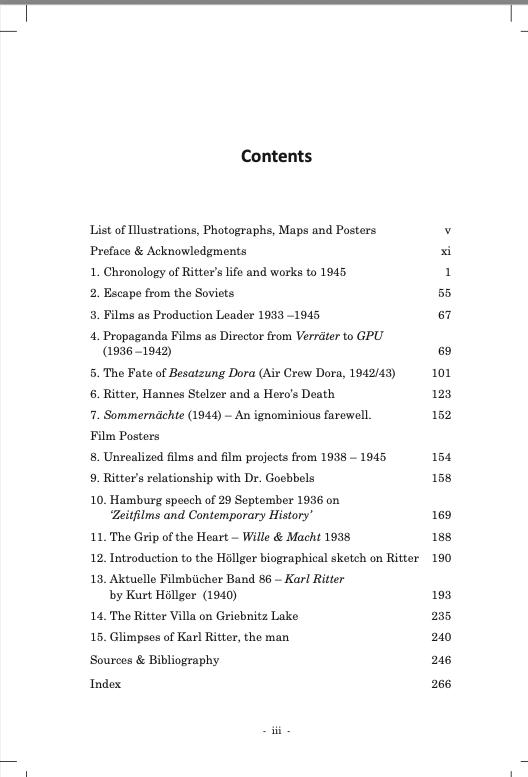
168 pages, extensive black and white photographs, 16 full colour plates of some of his most famous movie advertising posters
Currently selling on Amazon for £55 for USED
OUR PRICE £35 NEW
Related products
-
SALE

Feldherrnhalle: Forgotten Elite – The Panzerkorps Feldherrnhalle and Antecedent Formations, Eastern and Other Fronts, 1942-43 (Stahlhelm S.)
Original price was: £85.00.£45.00Current price is: £45.00.


