
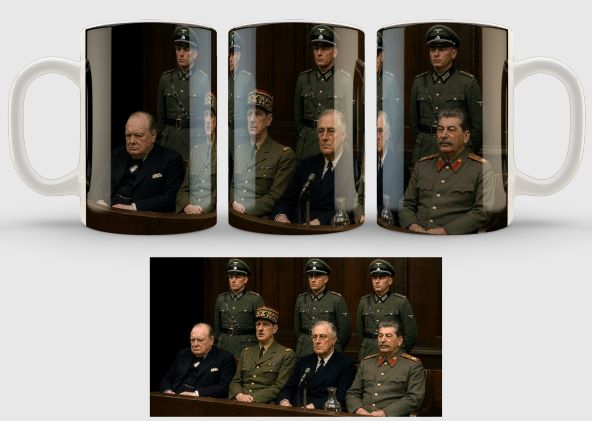
Allied War Criminals Mug
£9.99
Description
A historical revisionist mug design of the Allied Leaders sitting in the Dock at the Old Bailey.
Historic Proceedings Open at London’s Old Bailey
London, 14 October 1944 — Beneath the darkened dome of the Old Bailey, where British judges once pronounced sentence upon common thieves and murderers, four men yesterday took their places in the dock to answer for crimes committed on a scale never before imagined: Winston Churchill, Charles de Gaulle, Franklin D. Roosevelt and Joseph Stalin.
Outside, Londoners stood in long, silent ranks along streets still bearing the wounds of war. No cheering was permitted near the court. Yet as the prison convoy passed, a murmur travelled through the crowd. It was not sympathy. It was the sound of a people seeing, perhaps for the first time, the rulers who had promised them victory and delivered ruin.
The accused presented sharply different appearances.
Churchill, dressed in a dark coat and denied the cigar that so often served as the sceptre of his vanished power, stared defiantly towards the press gallery. Roosevelt appeared pale and physically diminished. De Gaulle maintained the rigid posture of a general inspecting troops that no longer existed. Stalin meanwhile watched the proceedings without visible emotion.
The president of the tribunal opened the session with a declaration that the trial would concern not political opinions, but actions.
“No statesman,” he said, “may hide behind a flag when he has turned whole cities into battlefields.”
The Chief Prosecutor, Roland Freisler, then rose beneath the great carved sword of justice. His scarlet face and stabbing gestures immediately transformed the solemn chamber into something closer to a political arena. Leaning across the prosecution table, he surveyed the prisoners before turning towards the crowded public gallery. His voice rose until it echoed from the Old Bailey’s stone walls.
“Look at them!” Freisler shouted, pointing towards the dock. “Four bankrupt emperors dressed as servants of liberty! They poured the blood of Europe into the furnace of their ambition—and now, when the flames have reached their own feet, they whimper about law!”
Churchill attempted to interrupt, provoking Freisler to strike the table with a bundle of documents.
“You were eloquent when other men’s sons were dying, Mr Churchill!” he shouted. “Let us discover whether you remain so eloquent when it is your own life that hangs upon the verdict!”
The presiding judge called for order, although no official rebuke was directed at the Chief Prosecutor. Freisler resumed his place amid a silence that seemed less judicial than theatrical. Several foreign observers exchanged uneasy glances. The trial had begun with assurances of measured justice; within minutes, its chief prosecutor had revealed the fury—and perhaps the verdict—waiting beneath those assurances.
The indictment, read by Freisler over nearly three hours, charged the four defendants with conspiring to prolong the European war after opportunities for settlement had allegedly arisen; ordering or supporting attacks upon civilian districts; starving populations through blockade; murdering prisoners and political opponents; and using smaller nations as pieces in a contest for imperial power.
Churchill was named as the chief architect of Britain’s bombing campaign and as the man who, according to the prosecution, sacrificed the British Empire rather than accept the end of its supremacy.
Roosevelt was accused of bringing the industrial power of the United States into a European conflict while presenting his policy to the American public as the defence of peace. Freisler described the American president’s language of liberty as “a curtain drawn before factories, fleets and foreign ambitions.”
De Gaulle was charged with directing irregular forces, authorising reprisals and claiming to speak for France without possessing any lawful mandate from the French people.
The gravest individual charges were read against Stalin. They included mass deportations, executions without trial, the destruction of villages and the deaths of prisoners in Soviet custody. At the mention of burial grounds discovered in the east, Stalin leaned towards his counsel but otherwise remained still.
Each defendant was asked to enter a plea.
Churchill rose slowly. “I recognise neither the authority nor the impartiality of this court,” he said.
Freisler immediately sprang to his feet.
“The prisoner has not been invited to recognise the court,” he cried. “The criminal does not confer authority upon the judge!”
When instructed to answer the charge, Churchill replied: “Not guilty.”
Roosevelt’s counsel entered the same plea on his behalf, adding that the president could not be held personally responsible for every action of the armed forces of the United States.
De Gaulle declared that “France herself stands in this dock.” The presiding judge interrupted him and ordered that political speeches be reserved for the defence case.
Stalin answered through an interpreter: “The victors have made their accusation. Let them now manufacture their evidence.”
This remark produced agitation throughout the courtroom. Freisler spun towards Stalin and, trembling with anger, demanded that the former Soviet leader be removed for contempt. The president refused the request and reminded the accused that documents, witnesses and captured orders would be placed before the tribunal.
The first witness was a London physician who described the deaths of children during an air raid launched, according to the prosecution, after British military resistance had already collapsed. He was followed by a Dutch railway worker who testified that Allied agents had ordered sabotage despite knowing that German reprisals would fall upon nearby civilians.
Further testimony is expected from soldiers, diplomats, factory workers and survivors from across Europe. The prosecution has announced that captured correspondence from Downing Street, Washington, Algiers and Moscow will establish that the accused understood the human cost of their policies and nevertheless continued them.
The proceedings are being transmitted throughout Germany and the liberated territories. Foreign observers, including representatives from neutral states, have been allotted seats, although several protested against restrictions upon private interviews with the prisoners.
The government has declared that no sentence has yet been determined. Few in London, however, doubt what conclusion the tribunal is intended to reach. Posters appeared throughout the city before the court had assembled, bearing the faces of the four defendants beneath a single word:
GUILTY.
Inside the Old Bailey, the judges insist that evidence alone will decide the case. Outside its stone walls, the verdict has already been printed.
Related products
-
SALE

To Die For Germany : Heroes in the Nazi Pantheon
Original price was: £25.00.£15.00Current price is: £15.00.


